
What can AI agents really take on in an SME?
An AI agent sounds like a digital employee that gets everything done on its own. In an SME the honest first use is narrower and less spectacular, and that is exactly what makes it useful.
Using AI well · 13 October 2026 · 9 min read
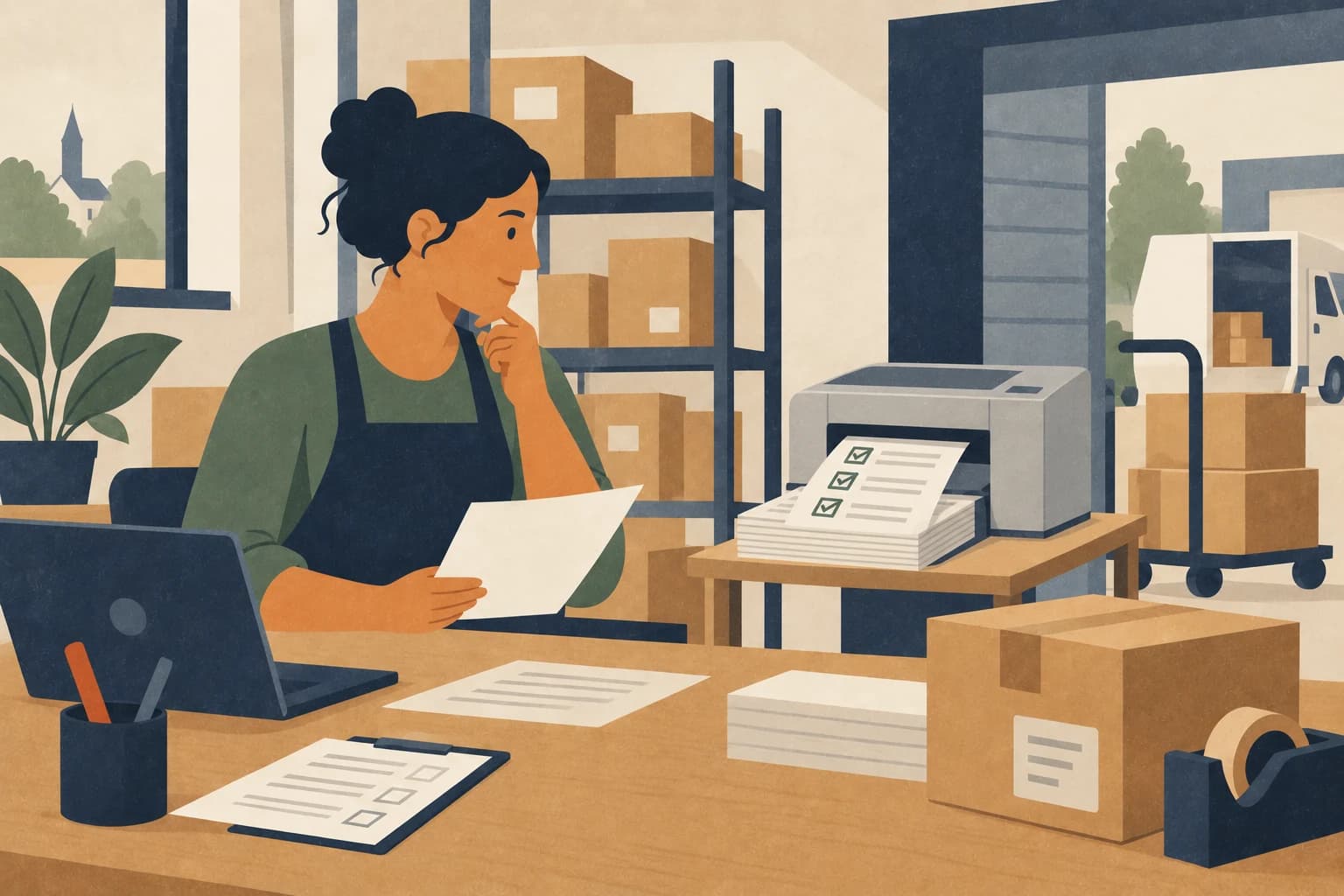
An AI agent takes in a task, plans the steps it needs, and carries them out itself with the right tools until the goal is met. That goes beyond a single chat answer. It can, for example, classify a request, search released sources, and prepare a reply draft.
Use an agent first where the workflow is frequent, the allowed actions are tightly limited, and a person checks the result before any high-impact action. For payments, price changes, legal commitments, or HR decisions, it is not a sensible first use. That limit holds today, not just at the start.
What sets a chatbot apart from an AI agent?
Ask ChatGPT a question and you get an answer. What happens next is up to you.
An agent goes a step further. It reads a request, recognises the topic, searches for information, and drafts a reply. With approval, it also calls a tool or updates data in a system.
A typical example: a trades business gets quote requests by email. An agent reads the request, routes it to the right trade, and drafts a reply. A person still checks and sends the quote with its price and commitment.
That is where the value is. That is also where the risk begins. The more an agent may do itself, the clearer its data access, rules, and approvals must be.
Chatbot, copilot, automation, agent: what is the difference?
- Chatbot: it answers an input. You carry out the next step.
- Copilot: it supports you directly inside your work, suggesting, summarising, or drafting.
- Classic automation: it follows fixed rules. If A happens, B follows. Good for predictable workflows.
- AI agent: it selects and runs several steps itself within a fixed frame. It therefore needs more control than a fixed automation.
Is every workflow better with an agent?
No. When the rules are stable, a classic automation is often cheaper and more reliable.
An agent pays off only once a workflow combines several decisions and changing information, for example when every request looks different but still has to reach the same outcome. Check first whether a fixed rule is enough. Only once that stops holding up is an agent worth a look.
Where does an SME start sensibly?
- Triaging requests: the agent recognises topic, urgency, and owner and suggests a category. Before a sensitive request moves on, you check the routing.
- Gathering information for a draft: the agent searches released sources and prepares a reply. You check prices, deadlines, and commitments separately.
- Preparing recurring reports: the agent collects released figures, flags anomalies, and drafts a first summary. The responsible person checks the data and the interpretation.
What if the workflow is already unclear?
An agent cannot replace a missing process. If nobody knows who owns a request, which source leads, or when a job is done, the agent only spreads that uncertainty faster.
So describe today's workflow first. What comes in? Which decision follows? What information is needed? Who checks? What may the system do on its own? Where must it stop? Only then can you decide whether an agent, an automation, or a better template is enough.
What does a good first agent look like?
Tightly bounded. It uses few approved tools, works with a manageable data source, and cannot trigger an irreversible action. Every uncertainty stays visible.
For the trades business from the example above, that means the first version only triages requests and drafts replies. It sends nothing, books nothing, and changes no price. That small scope quickly shows where rules are missing and how often you need to correct it.
Does your workflow suit an agent?
A workflow suits an agent better when several of these hold:
- The task happens frequently.
- It consists of several clearly named steps.
- The needed information is accessible and reliable.
- Allowed and forbidden actions can be separated.
- A mistake stays visible before a high-impact action.
- A responsible person can check the result.
- Benefit and correction effort can be measured.
Sources and further reading
FAQ
No. It should only see the information and tools it needs for its tightly limited task. Less access makes control easier and limits potential damage.
Technically yes. For a first pilot, a draft with human approval is usually the wiser choice. Prices, complaints, and binding commitments especially need control.
When the trigger, rules, and result are clearly predictable. A fixed automation is then usually easier to test and maintain than an agent.
No. Start with one tightly bounded workflow. Several agents increase coordination, cost, and sources of error. Complexity follows only once a simple pilot has proven its value.
Mygenzy works with small and mid-sized businesses on processes, marketing, and AI. This article was created with the help of AI and reviewed by people.
Find a workflow that deserves an agent
The Growth Check captures the bottleneck, data, room for action, and risk. After that it is clear whether an AI agent makes sense or a simpler change fits better.