
Business succession: how do you secure the owner's knowledge before they leave?
The successor takes over shares, customer list and machines. What the owner has in their head after decades in the business is in no handover contract.
Using AI well · 30 October 2026 · 8 min read
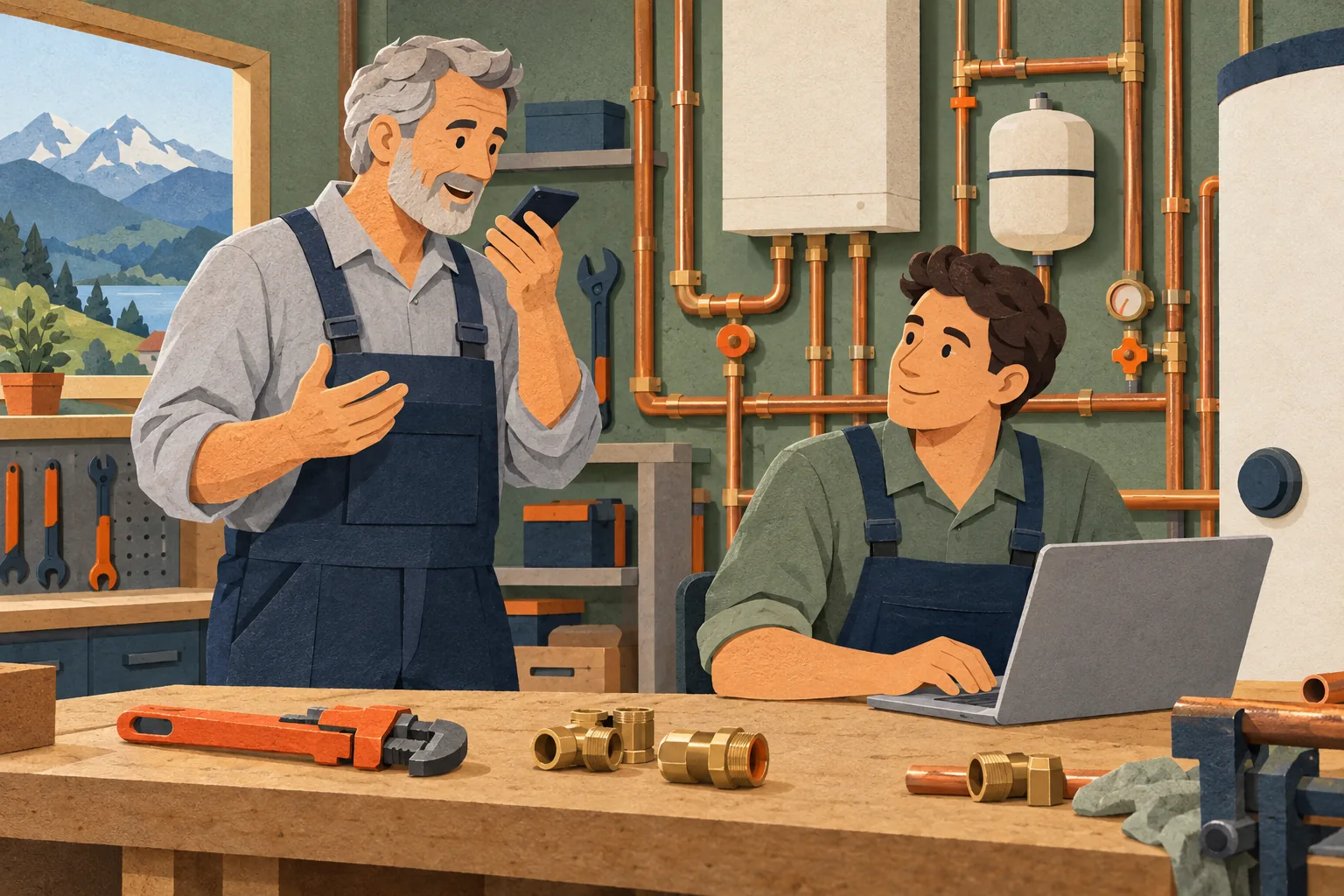
First name the cases where everyone calls the owner today. The owner records each case as a voice note, a colleague transcribes it, and a searchable file store makes the texts queryable with AI. The order matters: people first, then technology.
The AI sorts and finds. It knows nothing the owner has not said. Two things decide success: how early you start and where the data is processed.
The situation in small businesses
- 76%
- of owners see the business's success as strongly tied to themselves or to the manager
- almost 168,000
- SMEs face a change of ownership by the end of 2030, by extrapolation
- 58 years
- is the average age of the surveyed owners
UBS and the CFB-HSG family business institute, succession study 2026. Survey of 401 SME owners in Switzerland in September 2025, figures extrapolated.
What the handover contract does not cover
A contract covers price, shares and date. It does not say how the owner can tell that a job will cause trouble before the customer calls. The succession study names dependence on key people as a stumbling block. Successors fear that know-how and customer relationships leave with the owner.
Picture a machine builder in the Toggenburg handing over to their daughter. Price, shares and the lease on the hall are settled. Still open: one customer's installation always needs readjusting first after winter. Also open: for which cast part the supplier reacts differently on the phone than by email. Only the father knows.
The study recommends coaching the successor through the handover period, reducing dependence on key people and documenting processes.
Five steps you can start this week
Plan four weeks for the first round, not four months.
Name the cases
Write down which questions your people take to the owner today. Twenty cases are enough to start, for example «Why does customer X's installation not run on machine 2?».
Speak instead of write
After every job the owner speaks for two minutes into a smartphone: what was the problem, what did I do, what to watch for. That works on site or in the workshop more easily than a form.
The successor listens
On five to ten cases the successor accompanies the owner and asks the questions nobody has asked, because they are obvious to the owner.
One file store
One text file per case in one folder, with a date and a person who maintains it. The AI transcribes the voice notes and turns them into a short instruction. The owner reads each one once and corrects it.
The test
The successor answers twenty real questions using only the file store. If they cannot find the passage or it is wrong, you have found the gap before the owner is gone.

Three businesses, three kinds of knowledge
The scenes are examples, not client cases. They show what gets captured and where to be careful.
Machine building in the Toggenburg
The owner hands over to their daughter.
Capture this
One voice note per customer installation: what was ever adjusted, which parts fail first, which supplier delivers which part reliably. The AI turns it into one file per installation that the workshop manager can query.
Be careful here
Design drawings, price lists and customer contracts are trade secrets. They do not belong in a public chat service.
Fiduciary office in a regional town
The owner hands over to a long-standing employee.
Capture this
One note per client file on its quirks: who regularly delivers receipts late, which arrangement applies to the quarterly accounts, which deadline extensions the owner applied for in earlier years.
Be careful here
Names, figures and tax data of clients are personal data. Keep the note under a file number and process it only where you know the location.
Plumbing and heating in eastern Switzerland
The service fitter retires and knows the regular customers' systems.
Capture this
A voice note after every job, starting with systems whose nameplate is unreadable. The fitter reads each instruction once, and the successor joins him on the hardest jobs.
Be careful here
Access codes and key deposits do not belong in the note. They stay in the key system.
How the AI answers later
The method is called retrieval-augmented generation, RAG for short. The AI is connected to your texts. For every question the system first finds the matching passages and lets the model answer from them only. The SATW writes that RAG reduces errors and makes answers traceable. According to the SATW it needs a clean data basis.
If the new manager later asks «How do I handle customer X's installation?», the system shows the note with date and author. They see whether the answer is two months or two years old, and can call the fitter while he is still there.
Where your data may sit: three tiers
This is our own grouping. It helps when choosing the system:
- Tier 1, public knowledge: service descriptions, website text, standard answers without personal data. A cloud service is acceptable if it does not use inputs for training.
- Tier 2, internal content without personal data: workflows, checklists, installation settings. You need a contract with the provider and must know where it processes.
- Tier 3, personal data and secrets: customer files, contracts, personnel records, client figures. Processing belongs in Switzerland or in-house, with legal review beforehand.
Three ways to build it
Each costs effort or control:
- Ready-made assistant from Switzerland: Infomaniak runs the Swiss model Apertus on its own infrastructure in Switzerland and states it does not use transmitted content for training. The model alone is not yet searchable company knowledge, so you must clarify the document search.
- Your own RAG at a Swiss host: you run model, document search and database at a provider in Switzerland. The Apertus model is openly available. Someone has to build and maintain it.
- In-house: an open model runs on your own hardware and the data never leaves the building. This gives the most control, but you need hardware and operations.
What happens after the handover
A file store goes stale. Name one person per area who checks once a year what still holds. If the new manager starts with an instruction that turns out wrong, she corrects the file the same day.
Repeat the twenty test questions after three months, with questions that were really asked in the meantime. That is the most honest measure of whether the system helps the business.
Conclusion
Secure the owner's knowledge by naming twenty cases, capturing them as voice notes and letting the successor listen in. The AI makes the texts searchable later. This week, write down the twenty questions your people take to the owner today.
What may go into such a system is covered in What belongs in an AI policy for a small business? and Which data can employees enter into ChatGPT?. Where else AI saves time in your business is in Where does AI pay off in an SME?. We support the build with our AI consulting.
We find out which knowledge needs securing first
In the first call we look at where knowledge in your business hangs on one person and which route fits your data. Message us on WhatsApp or email, or call.
Keep reading
FAQ
As early as possible. According to the succession study, a change of ownership often stretches over many years in practice. Plan four weeks for the first round with twenty cases and extend case by case afterwards.
No. The AI takes notes, sorts and finds. What the owner does not mention because it is obvious to them only comes out in conversation with the successor.
Not all of it. Public knowledge may go to the cloud if the service does not use inputs for training. Personal data and trade secrets belong in Switzerland or in-house.
Not for a ready-made assistant. Your own RAG at a host or in-house needs someone to build and run it.
In the first call we go through which cases to secure first and which tier your data falls into. If you like, we build the first area with you.
Mygenzy works with small and mid-sized businesses on processes, marketing, and AI. This article was created with the help of AI and reviewed by people.